
By LILY APPLEBEE

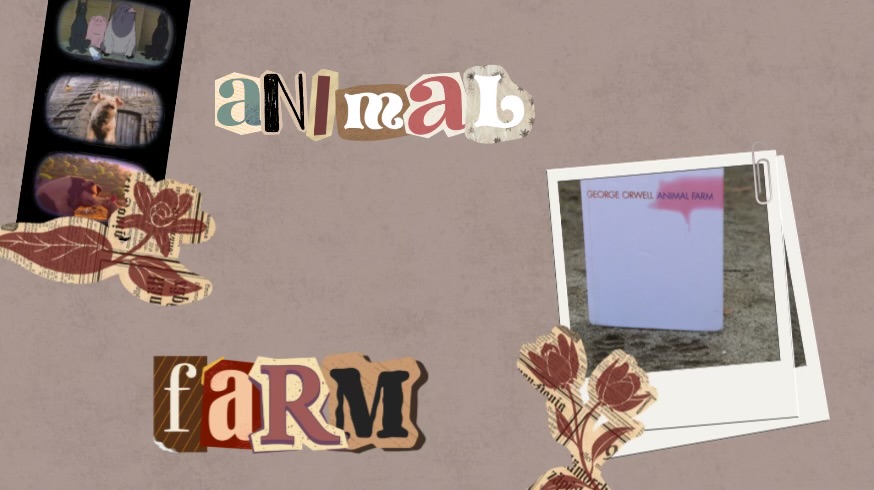
Featured Image: A digital collage with photographs of the book ‘Animal Farm’ in the bottom right while, in the top left, the 1954, 1999 and 2026 (in order from top to bottom) adaptations of the book showcase scenes encapsulated by a film tape. The title ‘Animal Farm’ is spelled out in various letters of different shapes, sizes and colors, and there are flowers cut out of newspaper partially covering the featured photos and movie scenes. (LILY APPLEBEE/Birdbox Image)
Warning: This article contains spoilers for the ‘Animal Farm’ book and movie adaptations.
On May 1, the latest adaptation of ‘Animal Farm’ will be released to theaters, but the public isn’t excited about this. The animated film is directed by Andy Serkis and written by Nicholas Stoller, and it appears, based on the trailers, that the book has completely slipped out of their minds.
‘Animal Farm,’ the 2026 movie, has been called a “15-year passion project” by Serkis, and there’s many reasons why it might’ve taken to produce the movie. First off, the casting is full of celebrities–such as Seth Rogen and Gaten Matarrazzo–with no small names in there, meaning there was likely a lot of time spent signing contracts and waiting for other shows and movies to finish using up their contracts. In addition to this, the plot has been rewritten to the point where audiences at practice screenings greatly protested upon viewing the film, and even Netflix gave up the distribution rights to the film and sold it to Angel Studios. This massive writing change and switch in studios could’ve also contributed to the many years spent.
Angel Studios is well-known for their blockbuster films based on iconic stories from the Bible, with their latest film being ‘David.’ While their previous films have made close to $85.9 million dollars, most of the public is skeptical that this film will even fill an entire theater with an eager and engaged audience, much less gross that much amount of money. So, as the movie releases to theaters, here’s what the trailers have shown us; bad and good.
Written by George Orwell in 1945, ‘Animal Farm’ is an adult fairytale made to be an allegory about communist Russia, and the ignorance shown by Britain, Germany and America towards its true nature. The novella follows the animals from their revolution to their eventual fall into tyranny, criticizing the same moments that occurred in Russia from the Russian Revolution to Stalin’s rise in power. For his allegorical purpose, Orwell has written the animals to represent different people, ideas or social classes. While the book ends on a drastically low note, it’s generally well-liked and considered a classic.
Despite its timely setting, the story remains relevant to this very day, with The New York Times describing it–on the back of the 75th anniversary edition of the book–as: “A wise, compassionate, and illuminating fable for our times.” By this claim, it’s no wonder that Orwell’s novella would be so widely received and reinterpreted over the years, but to say that his lesson has stood the test of Hollywood would be a lie.
1954 was the year that ‘Animal Farm’ was first adapted for the screens, and compared to its later reiterations, the message of the original novella seemed to stay true in the film, with only a slight twist. This film was made to be anti-communist propaganda and was sponsored by the C.I.A., and while it did still reveal the horrors faced in Russia, it completely left out the role of America’s ignorance to the true cruelty of Stalin’s communist Russia.
Orwell’s entire intention with his novella was to shed light on the violence and oppression occurring in Russia that the world was blatantly ignoring, but the C.I.A didn’t care for this message, instead using this film to leverage their idea that to defeat Stalinist Russia, a second revolution must happen so that freedom can be achieved. Surprisingly, this adaptation would be the most accurate compared to the later films.
In 1999, ‘Animal Farm’ returned to theaters for a second time, though this time, the animals seemed more alive. This was the wonderful work of Jim Henson’s Creature Shop, that made animatronics for every animal, and while they may look creepy now looking back at the film, for their time, this was new and fashionable technology.
Despite its “live action” feel and winning Best Special Effects at the 2000s Fantasporto International Fantasy Film Award, the film isn’t well-known, and there’s a fair reason for that. While the 1954 ‘Animal Farm’ had a compelling message for its time and terrifying sincerity, this film tried to actively distance itself from any connection to Russia, and in doing so changed many important details.
For example, Mr. Jones, the farmer, accidentally killed Old Major with his shotgun, and he and his wife later return to the farm to try and retake it despite never doing so in the book. By far, the biggest change was the removal of the mystery of the pigs. Throughout the book, we’re never allowed to know what the pigs are doing behind closed doors. It’s what makes the milk and apples disappearing in the beginning so foreboding, and what makes the pigs walking on their hind legs towards the end of the book as horrifying as it is. But in the movie, we see Squealer and Napoleon plotting, revising and making deals, which takes away from how unsettling they are as characters.
This happens in another way with Mr. Pilkington, who is one of Jones’ neighbors. In the novella, Pilkington makes several deals along the way with Napoleon before finally acknowledging all the pigs’ hard work at a banquet at the end of the book. As hateful as he is in spreading rumors, he never goes so far as to openly mock and manipulate Napoleon like in the film. This change brings into question, again, the agency and horror of the pigs, and even begins to erase that feeling of dread that they’re supposed to have. What truly erases their role as antagonists, though, is when the animals escape from the farm, only to return years later to find that Napoleon and Squealer are dead while the animals who were stuck under their regime are still alive, and even excited to see the escapee animals like Benjamin and Jessie, one of the dogs. This change, among others, does a lot of damage to Orwell’s original allegory while further setting up common trends that linger in the newest adaptation.
The characters of Orwell’s ‘Animal Farm’ have always been key to his allegorical message, and yet their representation has changed from adaptation to adaptation. Sometimes this is done to better fit the new message that the film is trying to promote, other times, the change is insignificant and even harmful to the plot of the film. In 2026, both instances can be seen in the trailers, though the latter change is more common and prevalent.
Napoleon (voiced by Seth Rogen) has faced the worst of it, as throughout the trailers it’s shown that his appearance, final moments, and now even his personality and allegory have shifted entirely. Who was once an allegory for Joseph Stalin in the book has become, essentially, a schoolyard bully who becomes a tyrant through the outside influence of Ms. Pilkington. This addition of an “outside evil” gives the audience the choice to view him as a sympathetic villain by placing the blame for his evil actions on Ms. Pilkington.
Aside from his change in allegory, Napoleon is also played in a more comedic light as seen in the first trailer, where, upon asking Lucky (voiced by Gaten Matarazzo) to read out the name written on the truck that has come to pick them up, exclaims: “Laughterhouse? I love to laugh!” and follows it up with Rogen’s iconic laugh.
While he does appear to get more serious, as seen in the final trailer, there are still so many moments like this where his purpose as a horrifying example of tyranny, and how it can sneak up when we least expect it, is lost. This is a shame to see, and so many have been outraged by Serkis and Rogen’s interpretation of him, rightfully so.

Featured Image: A screenshot from the first ‘Animal Farm’ 2026 trailer where on the side of the truck that has come to pick up the animals the word “slaughterhouse” is written in big, bold, yellow letters. (ANGEL STUDIOS)
His partner in crime, Squealer (voiced by Kieran Culken), has also changed, though not as severely. While being played like many villain’s sidekicks–that being humorously–Squealer still holds many of his manipulative tactics and his conniving mindset, though none of that would’ve been evident by seeing him in the first trailer. When he’s first introduced to us, it’s made clear that his charming and innocent attitude has been switched out for a sarcastic and childish one. This change, while odd, isn’t entirely bad, as it hints at internet culture and how being mean can be a hilarious trend. By making this change, his allegorical purpose of representing propaganda remains intact, just placed in a different medium.
Of course, these two would mean nothing without Snowball to counteract them. In the book, Snowball is representative of Leon Trotsky, who opposed Stalin in their electoral race, though he eventually lost and was exiled from Russia before later being assassinated in Mexico. Despite this, he remains a prominent character in the book, serving as a common enemy for Napoleon to unite the animals under for a short period of time.
Out of the two leaders, Snowball is generally more well-liked, which is what causes Napoleon to chase him out of the farm with the dogs (who represent the MGB). The final trailer features a scene alluding to this, which saves Snowball from the erasure and ignorance that he was given in the first trailer.

Featured Image: A screenshot from the final ‘Animal Farm’ 2026 trailer where Snowball, one of the main pigs in the film is cornered at the front door of a wooden shack by two dogs, who have most likely been sent by Napoleon, a rival leader to Snowball. (ANGEL STUDIOS)
Even still, so much damage has been done to his role, but some appreciation must be given to his voice actor, Laverne Cox, who has done an incredible job at repairing this by keeping her voice gender neutral as to be closest to his characterization in the book. Though, only so much can be done, as Snowball has been rewritten to be a sow (a female pig), despite being a boar just like Napoleon in the original novella and previous adaptations. Though this opens up a can of many uneasy questions, the change has been made, and it’ll be interesting to see how this plays out in the release of the movie.
When looking for good characters, our attention must be turned towards Benjamin (voiced by Kathleen Turner), and Boxer, (voiced by Woody Harrelson). Boxer, a carting horse, has long since been an allegory for the proletariats (also known as the working class), and while Benjamin, a donkey, plays a similar role, he is most reminiscent of the generation that lived and remembered the time before Stalin’s reign.
These two have always been a pair throughout every adaptation and the original book, so it’s wonderful to see that devotion between the two remains in the 2026 adaptation. That being said, a part of Benjamin’s character has been watered down, that being his cynicism toward everything. While in the book his cynicism is teased as being considered weird and dumb to the other animals, it’s never completely disregarded, and even becomes a focal point to lean on when the animals begin to believe the pigs’ lies despite all the proof and knowledge that Benjamin has disproving everything the pigs say. This is immensely important to the allegory that Orwell is trying to prove, and to water it down to the same level at which Eeyore’s cynicism is handled in ‘Winnie the Pooh’ is ignorant to the true power of what Benjamin represents.
Luckily, a new character takes up Benjamin’s role in making the animals question what the pigs say about everything, that character being a young piglet named Lucky. Boxer and Benjamin play a surprisingly supportive role to Lucky, with the two seeming like best friends with him from what the trailers have shown. Lucky is the P.O.V character, and that’s made very clear in both trailers. In the first trailer, he is torn between being on Snowball or Napoleon’s side, and in the final trailer, he is the leading instigator of the rebellion against Napoleon and Ms. Pilkington.
This, by all means, is an incredibly fascinating concept for a character, and very similar to four piglets in Orwell’s novella who also protest against Napoleon, though they inevitably end up dying before a second revolution can start. Lucky’s role is also reminiscent of other animals who featured–even just briefly–in the original book. He’s an important message about the dangers of neutrality and how important it is to use your voice. That being said, he didn’t need to become a character for the film, as many of the animals feel torn between Snowball and Napoleon, and Benjamin has long since held the role of being a challenger to the pigs’ messages.
While Orwell’s original telling blatantly follows the events of the Russian Revolution to the beginning of Stalin’s tyranny, this movie does no such thing, partially because its message has changed, though into what is hard to say with no official confirmation. That being said, the trailers seem to paint capitalism as the villain, with Ms. Pilkington highlighting all of the flaws within the economic idea. This isn’t bad, but it’s certainly odd considering teased merch and social media posts from folks working within the studios who seem to claim that it’s an anti-communism story. Though nothing can be said for sure, this confusion about the message has filled many with doubts about the could-be success of the film.
Another peeve about the storyline comes from its genre and age listing. The film is rated for ages “11 and up” (according to the final trailer) and is listed as a Fantasy and Comedy with a coming-of-age plot, which doesn’t match incredibly well with a story based on stalinism.
Though, for all the complaints about the story, Nicholas Stoller doesn’t stray too far from the key points of the story. In the beginning, the animals still rebel against Jones (voiced by Serkis). They establish a working society on the farm run by themselves and–though earlier than occurs in the book–trade with humans. The pigs are still set up as leaders with the added leverage of being “the brains” which leads to their eventual corruption, and they still live a life of leisure while the other animals work harder on shorter and shorter rations.
With so much staying the same, it seems like a wonder how convoluted the story may actually be, but based on some one particular screenshot from the final trailer (see below), I think it’s safe to assume that the story remains as confusing as it appeared in the first trailer.

Featured Image: A screenshot from the final ‘Animal Farm’ 2026 trailer where Lucky is on the left and Napoleon is on the right as they charge towards each other from on top of the water tank now floating in water that broke free from a far off dam. Fire is ignited in the background, and Lucky runs on four legs while Napoleon runs on his hind legs, showing the shift in both of them and their ideals. (ANGEL STUDIOS)
After so many references and screenshots from the trailers, it’s about time that we talk about them. The first trailer, released on Dec 12, 2025, is the worst of the two. It leans very heavily on the comedy and fantasy genre that it’s been labeled as.
Of all marketing choices to be made, playing “Feel It Still” by Portugal. The Man over clips of the movie has to be one of the worst choices made by the marketing team. Other movies, such as the first ‘Peter Rabbit’ movie have used that song in their trailer, though in their case, it fit. ‘Animal Farm’ is not supposed to be fun nor a kids’ story, and by all accounts, the animals in all previous versions of the story are rebelling for very valid reasons, that being Jones’ blatant mistreatment of the animals that leads to their starvation one fateful day. Their rebellion is not “just for kicks” as the song may suggest, and the choosing of this song showcases how sanitized and watered down the movie has made the story.
However, some redemption is made in the final trailer, when artist R A E N E (itsraenemusic on Instagram) covered “Blue Sky.” This song has been covered by many artists before, such as Frank Sinatra, Ella Fitzgerald and Willie Nelson, and it’s got iconically upbeat lyrics with an underlying, sad minor chord playing all throughout it. The song is a perfect fit for the final trailer, and should’ve been the song used originally in all trailers. It perfectly encapsulates the feeling and perspective of being animals on a farm, as well as all the emotions felt by them throughout the final trailer, all thanks to Raene’s vocal talent.
While there are many things wrong with this film as evidenced by the trailers, one thing remains clear: the animation and art team are carrying the entire story. Though it isn’t entirely clear in the first trailer, in the final trailer, color becomes a big part of the story. For example, scenes when the animals are starving or working to their breaking point are animated with duller, greyer tones, signifying the oppression and tyranny being expressed upon them by the pigs.

Featured Image: A screenshot from the final ‘Animal Farm’ 2026 trailer where several animals from the farm burst into a building, most likely a food storage unit, where at their feet lay a single seed, showing how the pigs are slowly cutting down more and more of their rations. (ANGEL STUDIOS)
In a later scene, when Boxer is struggling to drag a cart up a hill, the sun is setting behind him, painting everything in shades of yellow and red. This plays not just into the colors of the Soviet flag, but a tactic seen in propaganda art, where a leader is often equated with the sun, with the poster’s primary colors typically being yellow and red. This is incredibly interesting seeing as Boxer is not a leader–in the novella, he can’t even get past the letter D in the alphabet–but he is a strong piece of propaganda that the pigs use to stay in the animals’ favor.

Featured Image: A screenshot from the final ‘Animal Farm’ 2026 trailer where Boxer is seen struggling to pull a cart up a hill, even with the help from cows. In the distance, the sun is setting, painting the scene with a propagandized and tragic feel. (ANGEL STUDIOS)
Though the trailers have enough to suggest this movie being another aggressively average adaptation of Orwell’s ‘Animal Farm,’ some good can be found, and with the movie having been out since May 1, there may still be bits of treasure to be uncovered. Though, that’s for you to discover by watching it via Angel Studios streaming service, or on Amazon Prime, though you’ll have to pay money for the experience. Sadly, it has vanished from many theaters, even in its opening weeks, which has only fueled the reviews that have come out after its release.
Leave a Reply